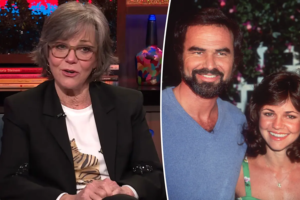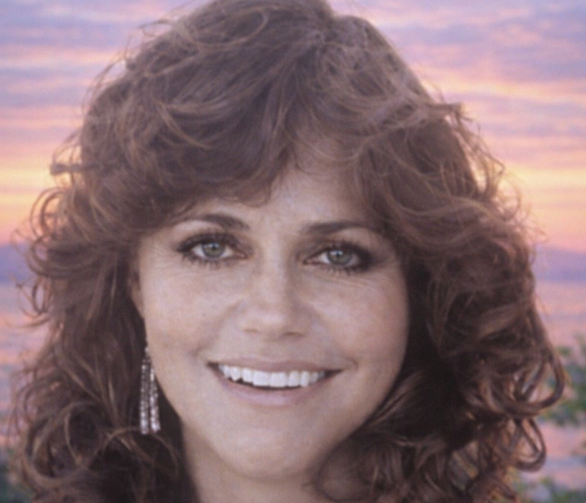
Throughout a career spanning six decades, Sally Field has cultivated a rare currency in Hollywood: absolute, unvarnished honesty. From her “you like me” Oscar acceptance to her visceral performances in Norma Rae and Lincoln, Field has never been one to hide behind a PR-sanctioned mask. It is this trademark vulnerability—a willingness to dissect both the accolades and the aches of her life—that has made her a permanent fixture in the American heart. In December 2022, the two-time Academy Award winner reminded audiences of that sharp wit during a high-energy appearance on Watch What Happens Live with Andy Cohen. When the inevitable question arose regarding her worst on-screen kiss, Field didn’t reach for a safe, forgotten co-star. Instead, she dropped a name that hit the headlines with the force of a cinematic plot twist.
At 76, with the benefit of decades of hindsight, Field named the late Burt Reynolds—her former co-star, longtime lover, and the premier masculine icon of the 1970s—as the man behind her least favorite cinematic smooch.
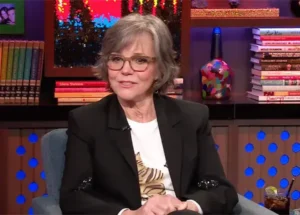
“Okay, this is gonna be a shocker. Hold on, folks,” she teased, the studio audience leaning in. “It’s Burt Reynolds.” The revelation was met with a roar of laughter, but Field, ever the technician of the truth, didn’t stop there. “It was just not something he really did very well,” she explained to a grinning Cohen, dryly noting that Reynolds’ technique involved a significant amount of “drooling.”
From the Open Road to the Red Carpet
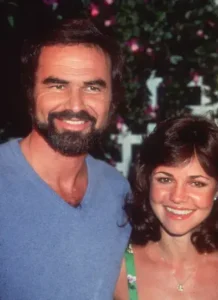
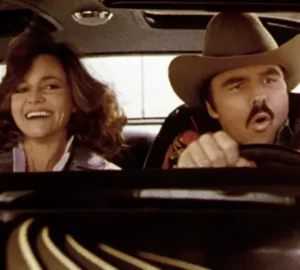
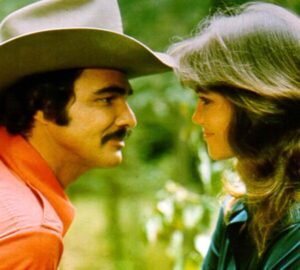
The history between Field and Reynolds is a central chapter in the mythology of New Hollywood. The pair first crossed paths in the mid-1970s after being cast in the high-octane road comedy Smokey and the Bandit (1977). The film was a cultural juggernaut, a box-office behemoth that fundamentally shifted both of their career trajectories.
Their undeniable on-screen chemistry ignited a real-world romance that spanned nearly five years. During this period, Reynolds was the world’s biggest movie star, a charismatic sex symbol who reportedly advocated for Field’s transition into more serious, mainstream cinema. Yet, while the public saw a glamorous “It Couple,” Field’s internal ledger of the relationship was far more complex—a turbulent mix of genuine affection and profound emotional discomfort.
A Public Confession with a Playful Edge
During her sit-down with Cohen, the host playfully interrogated the mechanics of the “unforgettable” kiss. When pressed on whether the encounter involved “tongue,” Field laughed but deflected with the precision of a veteran interviewee. She admitted it wasn’t “totally involved,” but returned to the awkwardness of the excess moisture that made the scenes a chore.
While the clip became an instant viral sensation, the comment wasn’t delivered as a mean-spirited jab. Rather, Field’s tone was reflective and humorous—the sound of a woman who had long ago processed the messiness of her youth and could now view it with the clarity of a seasoned observer.
The Shadow of “In Pieces”
To understand the “worst kiss” anecdote, one must look at Field’s broader reflections on Reynolds, who passed away in 2018 at the age of 82. In her searingly honest 2018 memoir, In Pieces, she painted a portrait of a romance that was as “confusing and complicated” as it was “loving and caring.” She admitted that while there was deep affection, the relationship was also “hurtful” in ways that took her years to fully unpack.
Field has been remarkably open about how her own personal history—specifically a difficult relationship with her stepfather—primed her for the controlling dynamics she encountered with Reynolds. She famously remarked that he was someone who was “not good for me in any way.”
There was also a disconnect between their shared reality and Reynolds’ later nostalgia. In the years following their split, Reynolds frequently referred to Field as “the love of my life.” Field, however, viewed this through a skeptical lens, suggesting that Reynolds had “invented in his rethinking of everything that I was more important to him than he had thought, but I wasn’t.”
In more recent interviews, including a 2024 retrospective, Field admitted that during their five-year run, she often felt “absent” from her own life. She described a constant pressure to adapt, to please, and to be the version of herself that Reynolds required, rather than her authentic self.
Two Narratives, One Legacy
For Burt Reynolds, the story of Sally Field remained a story of “the one who got away.” For Sally Field, the story is far more nuanced—a tale of a young woman finding her voice in the shadow of a giant, learning through both the “drooling” kisses and the emotional hurdles that her own truth was the only role worth playing.
In the years leading up to his death in 2018, Burt Reynolds often appeared to be an actor in the midst of a long, public confession. In interviews that served as a final act of sorts, he described Sally Field not just as a former co-star, but as the most significant woman of his life. He called her his “one true love” and frequently cited the end of their five-year relationship as the single greatest regret of his storied existence.
Hearing Reynolds speak in such haunting, elegiac terms added a poignant layer to the public’s understanding of their connection. It painted a picture of a bond where admiration, pain, and nostalgia were inextricably intertwined with a sense of missed possibilities.
Yet, Field’s own reflections offer a far more nuanced counter-narrative. While she has never shied away from acknowledging the “instantaneous connection” they shared during the high-speed thrill of the 1970s, she has steadfastly refused to romanticize the aspects of their partnership that were, ultimately, unhealthy for her. Her ability to navigate the emotional magnetism of their past while confronting the challenges they faced speaks to a broader, lifelong commitment to honesty—even when that honesty is uncomfortable.
The Viral “Drool”: A Masterclass in Authenticity
When Field’s revelation about her “worst on-screen kiss” went viral following her appearance with Andy Cohen, it triggered a media frenzy characterized by laughter and genuine surprise. For many fans, the delight was in the relatability; it was a reminder that even the most gilded Hollywood icons are subject to the same awkward, unglamorous moments as the rest of us.
Social media erupted with clips of the interview, but beneath the humor was a deep appreciation for Field’s character. In an industry often built on curated facades, her willingness to be candid and thoughtful—without the protection of a publicist’s filter—felt like a breath of fresh air. She transformed what could have been a mere piece of tabloid gossip into a moment of human connection and levity, proving that her cultural relevance remains as sharp as ever.
A Career Defined by Depth
Field, now in her late seventies, has forged a legacy that transcends the awards on her mantle. While her Academy Award-winning turns in Norma Rae and Places in the Heart established her as a titan of the craft, it is her emotional transparency that has cemented her as a beloved figure. Whether on the screen, the stage, or the page of her memoir, Field has consistently gravitated toward roles that demand a profound level of vulnerability.
Her openness about her personal life—including the complexities of the Reynolds era—serves as a reminder that actors are constantly navigating a maze of relationships both in front of and away from the camera. For Field, the “story behind the story” is often just as compelling as the performance itself. Her reflections do not diminish her career; rather, they enrich it, inviting her audience to see the breathing, evolving human being behind the iconic roles.
Legacy, Lessons, and the Value of Growth
As we look back at this viral confession within the broader arc of Field’s life, a clear theme emerges: she is a champion of personal growth. Whether she is discussing the mechanics of an awkward kiss or the deeper psychological impact of a long-ago romance, she speaks with a blend of humor and hard-earned wisdom.
Her anecdote about Reynolds’s technique—notably the “drooling”—sparked laughter, but it also offered a window into how memory and experience shape our perspectives over time. It is a testament to the idea that life’s most indelible moments aren’t required to be perfect. Sometimes they are messy, sometimes they are embarrassing, but they are always deeply human.
The Final Word on a Pop-Culture Moment
Ultimately, Sally Field’s revelation remains a landmark pop-culture moment not because it was “shocking,” but because it revealed her unique ability to blend humor with reflection. She reminded the world that even behind the most storied Hollywood careers lie off-camera complexities that are rarely seen in the final edit.
By telling her story with truth and grace, Field has shown that the personal narratives we carry—those defined by our own boundaries and growth—are often as fascinating as the films that made us famous in the first place.