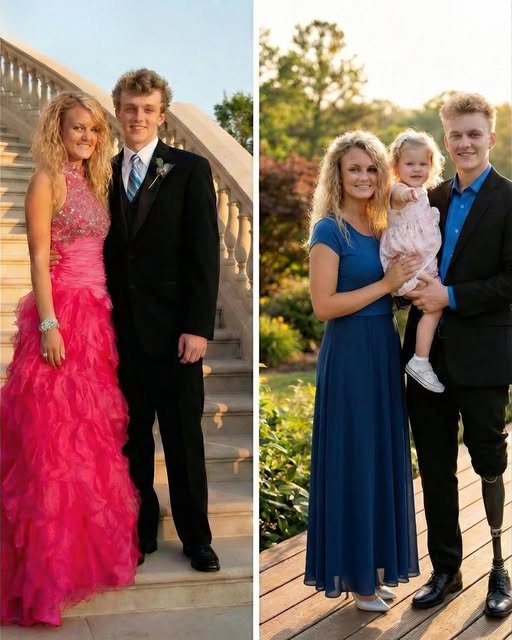
Statistically speaking, Savannah Combs was already navigating a narrow corridor of probability. While the rate of twin births saw a dramatic 72 percent surge between 1980 and 2018, the occurrence remains a biological exception, accounting for roughly 33 out of every 1,000 births. When you isolate identical twins, the numbers plummet further to just three or four per 1,000.
But for Combs, a 23-year-old from Middleburg, Florida, the math was about to become astronomical. After discovering she was pregnant with twins, she was hit with a second, far rarer revelation: both of her daughters had Down syndrome.

A One-in-Two-Million Journey
The news was, understandably, an emotional watershed for Savannah and her husband, Justin Ackerman. The couple was acutely aware of the societal stigma and the potential for judgment that often accompanies a Down syndrome diagnosis. To Savannah, however, the rarity of her daughters’ condition didn’t make them a burden—it made them “gems.”
“It’s very rare what they have, but they’ve been my little gems,” Savannah told News4JAX.
The technical term for her pregnancy was “mono di” (monochorionic diamniotic) twins, meaning the babies developed in separate sacs but shared a single placenta, ensuring they would be identical. To have “mo di” twins is a medical rarity in itself; to have both twins diagnosed with Down syndrome pushes the probability into the realm of one in two million.
The road to their arrival was fraught with pressure. In her viral TikTok videos documenting the journey, Savannah revealed that she was advised to abort the pregnancy under the assumption the babies would not survive. She refused, choosing instead to give them a fighting chance.
”Every [prenatal] appointment they were alive was a blessing to me,” she explained.
Milestones and “Feisty” Spirits
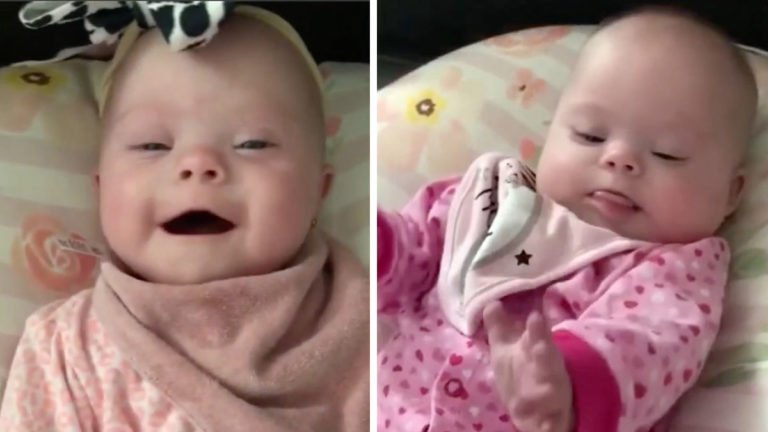
With her husband away at boot camp, Savannah faced the final stretch of her pregnancy alone. At 29 weeks—two months ahead of schedule—she was admitted to the hospital. On May 12, 2021, Kennadi Rue and Mckenli Ackerman were born. Given their premature arrival, the twins spent several weeks in the Neonatal Intensive Care Unit (NICU) before finally being cleared to go home.
Today, Savannah uses social media to bridge the gap between public perception and her daily reality. She describes her daughters as “feisty” and “happy,” emphasizing that while they may reach their developmental milestones a step behind their peers, they are undeniably moving forward.
“They have feelings. They have a beating heart. They know how to talk. They know how to do things you do. They will get there,” Savannah said. “I’m going to let them know that they’re just like us and they’re going to get there as long as they put their minds to it.”

Confronting the Critics
Despite the heartwarming nature of her updates, the digital landscape has not always been kind. Savannah has frequently found herself on the receiving end of profound insensitivity. One user went as far as to tell her, ”I wouldn’t want those babies; if mine came out like that, they would be straight up for adoption.”
Savannah’s response, shared via Facebook, was a masterclass in grounded grace and parental conviction.
“I said, good thing they weren’t born to you and were born to me,” she wrote. “God knew what he was doing by giving these babies to the right parents who would love them regardless.”
As Kennadi and Mckenli continue to grow, their mother remains their fiercest advocate, proving that while their diagnosis is rare, the love required to raise them is universal. They are a testament to the fact that life, regardless of how many “steps behind” it may seem, is a journey worth taking.