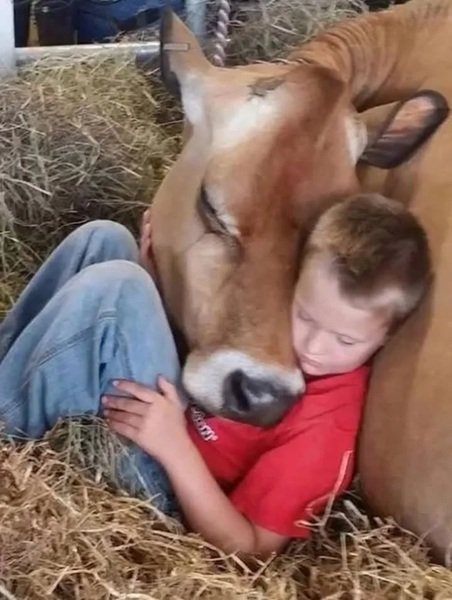
In the rural heartland, silence is usually a seasonal guest. It is the hushed anticipation of the first frost or the meditative stillness that follows a long day of harvest. But on our family farm, the silence has curdled. It has taken on a physical density, a weight that doesn’t just sit on the land but sinks into the black earth and curls like smoke around the hand-hewn beams of the barns. This is not the peace of the countryside. It is a haunting. And it began when the sound of my younger brother, Leo, simply went out.
Before last fall, Leo was the farm’s living pulse. He was a “whirlwind” in the most literal sense—a frantic, joyous energy that seemed to vibrate against the backdrop of the cornrows. You didn’t see Leo so much as you heard him: the thud of boots against the hayfield, the sharp crack of a fence being scaled, and a laugh that seemed to dare the world to catch him. He was the kind of child who kept the adults in a state of constant, exhausted amusement.
That boy vanished in October. The physical shell remained, but the spirit—the boy who filled the air with questions and noise—evaporated. What replaced him was a shadow, a child who speaks only in the kind of fragile murmurs one uses when they believe sound itself has become a predator.
The Sanctuary of the Barn
The shift was gradual enough for my parents to miss. To them, it was a “phase,” a byproduct of adolescence or the overactive imagination of a farm kid. But I watched the layers peel away. I watched his confidence turn to caution and his laughter to a heavy, watchful stillness.
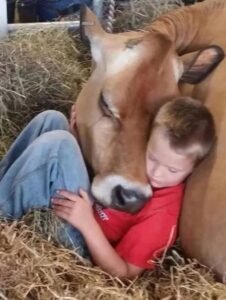
Everything traces back to a late October afternoon. We had wandered beyond the old stone perimeter into the deep woods where the creek runs cold. Whatever happened there—whatever Leo saw or did—remains locked behind his teeth. But the fallout was immediate. He abandoned our shared bedroom, refusing to touch the blankets or even step over the threshold. He sought refuge in the old barn, sleeping in the hayloft beside Daisy, our aging Jersey cow.
To an outsider, it’s a pastoral image: a boy seeking comfort in the steady, rhythmic heartbeat of an animal. To me, it was a red flag. Daisy offered Leo the one thing the rest of us couldn’t: a witness who could never testify.
I confirmed my fears a few nights ago when I followed him into the shadows of the loft. In the dim moonlight, I heard him whisper to the cow, his voice a ghost of itself: “I didn’t tell them it was me… Thank you for not saying anything.”
The Red Toolbox
The confrontation happened the following day behind the grain silo. When I pushed for the truth, the coil finally snapped. Leo didn’t fight; he collapsed into a state of raw, jagged terror. He gripped my hand with a desperate strength and issued a plea that would change the trajectory of my life: “Don’t open the red toolbox. And don’t show anyone the picture. Promise me.”
In the world of investigative journalism, we talk about the “smoking gun.” On our farm, it was a chipped, red metal box buried beneath rotting burlap and floorboards in the tool shed. When I finally pried it open, the air in the shed seemed to thicken.
Inside was a Polaroid, grainy and curled at the edges. It captured the woods near the abandoned stone well at our property’s edge. A figure in Leo’s blue windbreaker stood near the dark mouth of the well. At his feet lay something that made my stomach turn.
Beneath the photo was a collection of foreign objects: a single cufflink, a set of car keys, and a nameless leather-bound notebook. The pieces didn’t just fall into place; they slammed. I remembered the hiker who vanished in the nearby state park last fall. I remembered the search parties that eventually went home, and the news cycle that moved on.
Leo hadn’t just seen something; he was carrying the physical evidence of a tragedy. He wasn’t sleeping in the barn for comfort—he was hiding from the weight of a secret that had ended his childhood.
The Language of the Silent
In the weeks since I found the toolbox, I have become an accomplice to the silence. I watched as Leo moved through the winter landscape, a boy aging decades in a single season. He no longer plays; he works with a ritualistic, almost frantic diligence, tending to the livestock as if his labor could atone for the things he carries.
I attempted to reach him once, in the quiet of the hayloft. “Leo, I saw the notebook… You don’t have to carry it alone.” His response was a chilling reminder of the burden he’s chosen. “I don’t want them to know. They can’t understand.”
He is protecting us. He is shielding our parents and our world from a truth that would shatter the fragile peace of the farm. He has become the silent guardian of the unspeakable, and I have become his silent shadow.
As a journalist, I am trained to believe that the truth must be told, that light is the best disinfectant. But as a brother, I’ve learned a harder lesson. Some truths are too heavy for the world to bear. Some secrets are meant to be buried beneath the floorboards, guarded by a boy and a cow in a drafty barn.
The farm feels louder now, but it is the noise of the unsaid. Every creak of the house and every rustle of the wind in the bare trees seems to carry the weight of that red toolbox. I have learned that silence is not the absence of sound; it is a form of protection. It is a sanctuary. And as the snow buries the fields in white, I realize that I am no longer just a witness. I am part of the silence now.