The asphalt of Highway 80 cuts through the Texas plains like a jagged scar, long, unbroken, and shimmering under the oppressive weight of the afternoon heat. For Deputy Ryan Miller, this stretch of road is a daily office, the rhythmic hum of tires on pavement a sound as familiar as his own heartbeat.
But Miller doesn’t drive alone. Beside him, in the cruiser’s reinforced tactical kennel, sits Duke. A seventy-pound Belgian Malinois with alert, amber eyes, Duke is a partner that misses nothing. To the casual traveler, Highway 80 is a transit route; to Miller and Duke, it is a hunting ground where the smallest details dictate whether a life is saved or a soul vanishes into the ether.
The Ghost of a Waved-Through Stop
Miller’s intensity is born from a haunting history. Years ago, he made a mistake that still robs him of sleep: a routine traffic stop he waved through without a second thought. Hours later, a family was reported missing. Two children were never found. That failure carved a permanent edge into his psyche, reshaping the way he surveys the world.
Since that day, Miller has trained himself to read vehicles with the clinical precision of a forensic analyst. He looks for suspensions that sag too low, fresh bolts glinting where rust should be, and drivers whose smiles arrive exactly one second too late. Duke has evolved alongside him, tuned to the pheromones of fear and the subtle, rhythmic signals of living cargo.
The Blue Ford and the “Ordinary” Load
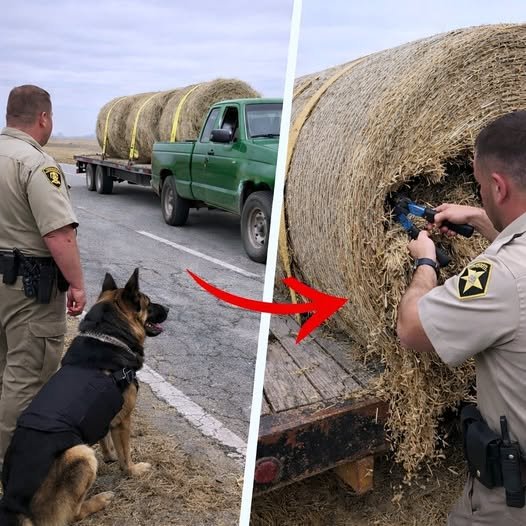
The sun was hanging low on the horizon when Miller spotted the blue Ford pickup. It was pulling a trailer stacked high with hay bales—a sight as common as dirt in ranch country. However, Miller’s eyes went straight to the rubber. The rear tires bulged under a strain that did not reconcile with the weight of dried grass.
Miller eased the cruiser behind the truck, observing the driver’s posture. The man’s hands were locked at ten and two, his shoulders stiff, his eyes darting to the rearview mirror with obsessive frequency. When the truck drifted onto the gravel shoulder without cause, Miller engaged the lights.
The driver, Stephen Kovich, radiated a scent of sweat and panic. His story was a patchwork of contradictions—odd jobs and vague deliveries that failed to form a coherent narrative. Miller opened the cruiser’s kennel. Duke leapt to the pavement, muscles taut, his nose already dissecting the air.
As they walked the length of the trailer, the transformation in the dog was instantaneous. At the third bale from the rear, Duke froze. Then came the eruption: sharp, frantic barks and pawing—the signal for a “living find.”
Inside the Hay: A Cargo of Souls
Peeling back the hay revealed fresh plywood, hurried and screwed into place. When Miller ripped it free, he was met by a pair of wide, terrified eyes. A young woman, barely conscious, her lips tinged blue from a lack of oxygen.
As Miller moved to assist, Kovich lunged toward the cab for a shotgun. Duke was faster. The Malinois launched himself with predatory speed, slamming the suspect to the dirt and locking his jaws on Kovich’s arm until the handcuffs were snapped shut and the weapon was kicked aside.
The rescue was a grueling process of dismantling hidden compartments. Bale by bale, Miller uncovered a human smuggling operation in its most visceral form. Eight people in total—men, women, and two children—were packed into spaces that reeked of urine and absolute terror. Some sobbed; others were past the point of sound.
The Standoff and the Aftermath
As Miller radioed for backup, a black Chevrolet Tahoe with darkened windows slowed on the horizon, approaching the scene. In a moment of sheer nerves, Miller stepped into the open, hand on his sidearm, bluffing a numerical advantage he didn’t have. Duke stood at his heel, teeth bared—a living, snarling warning. After a tense stalemate, the Tahoe turned away and vanished into the dust.
The silence was eventually broken by the cacophony of sirens. Paramedics flooded the shoulder, lining it with stretchers and oxygen masks. The bust provided the thread that allowed investigators to unravel a major smuggling ring, leading to multiple arrests across the region.
Days later, Miller walked the halls of the local hospital. The first woman he had pulled from the plywood tomb wrapped her arms around him, weeping. Miller, reserved as ever, gently pulled back and showed her a photo on his phone: Duke, tongue out and eyes bright.
“I didn’t see you,” Miller told her quietly. “He did.”
Tonight, Deputy Miller is back on Highway 80. The road hasn’t changed, but the weight on his shoulders feels slightly lighter. Duke rests beside him, eyes open, watching the shadows.