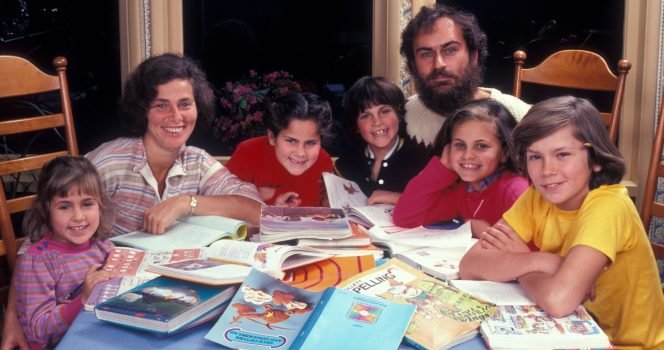
In the landscape of modern cinema, few figures are as enigmatic or as profoundly transformative as Joaquin Phoenix. He is an actor who does not merely perform; he disappears, re-emerging as figures that haunt the cultural zeitgeist, from the tormented Arthur Fleck to the brooding Napoleon Bonaparte. Yet, to understand the raw, often jagged emotional depth Phoenix brings to the screen, one must look back at a childhood defined by countercultural chaos, nomadic poverty, and the shadow of a religious sect. The man the world now knows as a multi-award-winning titan was born Joaquin Rafael Bottom in San Juan, Puerto Rico. He was the third of five children born to John Lee and Arlyn Bottom, a couple who, in 1969, abandoned the conventional comforts of California to seek a spiritual utopia. Their search led them into the embrace of “The Children of God,” a controversial religious group that would later be identified as a dangerous cult.
A Nomadic Childhood in the Shadows
For the first years of Joaquin’s life, the family lived a nomadic existence across South America, fueled by a zealous, if misguided, devotion to the group’s ideals. The environment was one of extreme poverty and strict control. The Phoenix siblings were not typical children; they were small cogs in a religious machine, often found on street corners handing out pamphlets or soliciting donations for the church.
The illusion of community shattered in 1978. The final catalyst for their departure was a directive from the cult’s leader, David Berg, who instructed members to use sexual “recruitment” to bring in new followers. Disillusioned and wary, the Bottoms fled. They would later learn that the group was under investigation by Interpol and that Berg was a man accused of the unthinkable, including murder.
Reflecting on those years in a 2014 interview with Playboy, Phoenix offered a nuanced perspective on his parents’ choices:
“I think my parents thought they’d found a community that shared their ideals. Cults rarely advertise themselves as such… I think the moment my parents realized there was something more to it, they got out.”
The Birth of the Phoenix
Seeking a symbolic “reset,” the family moved to Florida to live with Arlyn’s parents. To mark their resurrection from the ashes of their former life, they took a new surname: Phoenix.
The family’s journey to Hollywood is the stuff of cinematic lore. Virtually penniless, the seven of them crammed into a battered station wagon with a missing rear window and headed for Los Angeles. The financial strain was so acute that they were forced to give away the family dog because they simply “couldn’t afford an extra mouth to feed.”
Success, however, found them quickly. Arlyn secured a secretarial position in the casting department at NBC, providing a vital bridge into the industry for her five talented children. By age eight, Joaquin booked his first professional gig, an experience he later described to The Guardian as a moment of “instantaneous joy.” It was a physical, powerful sensation he admitted he has been chasing in every role since.

In the Shadow of River
Despite his early start, Joaquin spent the first decade of his career in the immense shadow of his older brother, River Phoenix. While Joaquin’s career seemed to simmer, River became the definitive voice of a generation, an Oscar-nominated superstar. Joaquin was frequently relegated to the status of “the second most famous” sibling, a perception that seemed to stall his momentum.
Everything changed on a tragic night in 1993. Outside the Viper Room on the Sunset Strip, River Phoenix collapsed from a fatal overdose of cocaine and heroin. Joaquin was the one who made the harrowing 911 call, his voice trembling with desperation as it was broadcast to the world—a recording that would serve as the grim soundtrack to his 23-year-old brother’s final moments on a Hollywood sidewalk.
Acclaim and Rebirth
Following the tragedy, the family retreated to Costa Rica to grieve in a vacuum, far from the prying eyes of the paparazzi. Joaquin didn’t return to the screen for three years, until he was called to audition for To Die For (1995). The film’s director, Gus Van Sant—a close friend of the late River—was reportedly moved to tears upon seeing Joaquin. For the younger Phoenix, the role was a clarion call, a reminder of the power of the craft he had almost left behind.
Today, the trajectory of Joaquin’s career serves as a bittersweet legacy. He has achieved the pinnacle of critical and commercial success that many believed was destined for his brother. From his Oscar-winning turn in Joker to his visceral portrayal of Johnny Cash in Walk the Line, Phoenix has turned a childhood of “countercultural chaos” into a career of unparalleled emotional honesty.
It has been a quarter-century since Joaquin Phoenix’s chilling turn as the petulant Emperor Commodus in Gladiator (2000) recalibrated his career. The Ridley Scott epic was a juggernaut, grossing over $400 million and effectively silencing any skeptics who doubted Phoenix’s leading-man potential. Since that breakout moment, he has become the industry’s premier architect of the “dark and magnetic,” building a trophy shelf that validates his standing as one of the finest actors of his generation: an Academy Award, a BAFTA, a Screen Actors Guild Award, a Grammy, a Volpi Cup, and two Golden Globes.
Beyond the accolades, Phoenix’s career is tethered to a unique piece of Oscar history. When he received his first nomination for Gladiator, he and his late brother, River—who was nominated in 1988 for Running on Empty—became the first brothers in history to both earn acting nods from the Academy. To this day, they remain the only pair to hold that distinction.
Remembering the “Guiding Light”
While Joaquin has spent much of his career maintaining a stoic silence regarding his brother’s passing, the 51-year-old Joker star recently offered a rare glimpse into their bond. Speaking on comedian Theo Von’s This Past Weekend podcast, Phoenix reflected on the “mythical” quality of River’s short but impactful life.
“My brother was quite a force and was definitely, like, I don’t know if it was mythical or Shakespearean,” Phoenix recalled. “He was kind of like the guiding light in some ways. He was the one who acted first. We used to sing on the streets and he played guitar and kind of like oversaw everybody.”
A Life Defined by October 1977
Phoenix’s intensity on screen is matched only by his fierce commitment to animal rights, a passion that can be traced back to a singular, traumatic moment on his third birthday.
In October 1977, as the family fled their life within the Children of God cult aboard a cargo ship bound from Venezuela to Miami, Joaquin and his siblings witnessed fishermen hauling in flying fish. The sight of the creatures thrashing and dying violently on the deck left an indelible mark on the young boy. As he later told Vanity Fair, the event sparked a moral awakening. Within two months of arriving in Florida, the entire Phoenix family transitioned to a vegan lifestyle—a conviction Joaquin has upheld for nearly five decades. Today, he remains one of Hollywood’s most visible advocates, producing documentaries that scrutinize the environmental and ethical costs of global meat consumption.
A Private Union in the Hollywood Hills
In his personal life, Phoenix has found a steadying force in actress Rooney Mara. The two met on the set of Her in 2012, maintained a friendship, and eventually began a romantic relationship while filming Mary Magdalene four years later.
The couple, who became engaged in 2019, have since expanded their family. They welcomed their son, named River in honor of Joaquin’s brother, in August 2020. In June 2024, they celebrated the birth of their daughter, Sparrow. While the pair are notoriously private, Phoenix referred to Mara as his “wife” during a September 2024 interview on the Talk Easy podcast, hinting at a settled, domestic chapter for the often-elusive actor.
Mara, speaking on the LaunchLeft podcast, described their Hollywood Hills home as a “creative household” where the conversation rarely feels like “two actors talking shop.” For Phoenix, life away from the camera is surprisingly grounded; the Academy Award winner spends his time meditating, watching documentaries, reading scripts, and practicing karate, a discipline in which he holds a black belt.
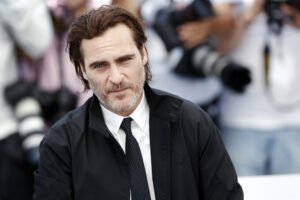
The Architecture of an Icon
From the nomadic chaos of his youth to the profound grief of losing a brother on a Hollywood sidewalk, Joaquin Phoenix has spent a lifetime transforming personal pain into cinematic gold. Whether he is channeling the fragility of Johnny Cash or the madness of the Joker, he remains a fearless explorer of the human condition.
His journey serves as a reminder that the most magnetic talents are often forged in the fires of real-world experience, requiring equal parts courage, heart, and a willingness to step into the dark.