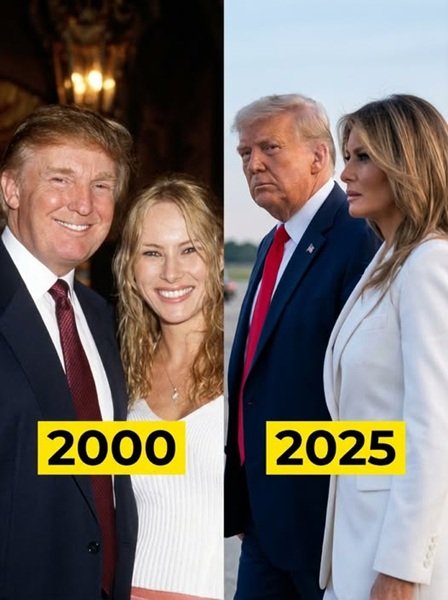
For a woman who has occupied the most scrutinized role in American public life for much of the last decade, Melania Trump remains a figure defined more by what she withholds than what she reveals. At 55, the twice-serving First Lady has cultivated a reputation not as a high-visibility political operative, but as a personality of measured, almost clinical restraint. From the fashion runways of Milan to the historic corridors of the White House, her presence is a study in deliberate composure—a trait that makes her notoriously difficult for the press and the public to “read.” To decode the persona of Melania Trump is to look at a life constructed with precise boundaries, beginning long before she became the only naturalized U.S. citizen to serve as First Lady.
From Sevnica to the Skyscrapers: The Knauss Evolution
Born Melanija Knavs in 1970 in Novo Mesto, Yugoslavia (now Slovenia), her roots were firmly middle-class. Her father worked in automotive sales and her mother in textiles—a background far removed from the gold-leafed penthouses of Manhattan. Discovered by a photographer at 16, she traded a nascent interest in architecture for the high-stakes world of European modeling.
By 1996, she arrived in New York City. Living a modest existence at first, she navigated the fashion circuit with a discipline that would later define her political tenure. It was here, in 1998, that she met Donald J. Trump. Their 2005 wedding in Palm Beach was a spectacle of 21st-century luxury, marking her final transition from an international model to a fixture of the American elite. In 2006, she gave birth to their son, Barron, and became a U.S. citizen, solidifying her place in the American story.
The 2016 Pivot and the “East Wing Silence”
When Donald Trump launched his 2016 presidential bid, Melania chose a path of tactical modesty. Unlike the highly visible advocacy seen in many political spouses, her role was characterized by a quiet, watchful presence. Even when controversy erupted—such as the 2016 convention speech that mirrored Michelle Obama’s or the “Access Hollywood” tape—Melania remained publicly undisturbed.
Those in her inner circle, including former aide Stephanie Winston Wolkoff, noted a profound calmness during media firestorms. This stoicism was often misinterpreted as detachment; however, closer analysis suggests it was an intentional strategy of self-preservation. Upon her husband’s victory, she made the unconventional choice to delay her move to the White House until June 2017, prioritizing her son’s schooling—a clear signal that her family’s internal structure would not be dictated by political optics.
“BE BEST”: Advocacy in a Digital Age
In 2018, the First Lady launched BE BEST, an initiative focused on children’s well-being with a specific lens on online safety and the opioid crisis. Her advocacy was notably non-ideological. She spent her tenure visiting hospitals, schools, and military bases, but she did so through a controlled, issue-oriented framework rather than a partisan one.
Her multilingualism—she is fluent in Slovenian and English—and her curated fashion choices became a sort of “visual diplomacy,” but they also served as a shield. Former Press Secretary Stephanie Grisham observed that Melania values stability and defined roles over the fickle nature of public opinion. For Melania, silence is not an absence of opinion, but a form of personal agency.
The Second Act: 2025 and the Bestselling Memoir
Following a period of relative privacy in Florida post-2021, Melania returned to the role of First Lady in January 2025. This second term has seen her balancing her traditional duties with a more assertive ownership of her narrative. Her memoir, Melania, became a bestseller, offering a rare, firsthand reflection on her journey from Slovenia to the global stage.
In this “Second Act,” she continues to champion the pillars of her initial advocacy while maintaining the boundaries she established years ago. She remains a figure who does not offer unfiltered interviews or unscripted commentary.
Conclusion: The Agency of Restraint
What observers often mistake for an enigma is, in fact, a carefully calibrated professional philosophy. Melania Trump’s public silence and emotional restraint are not accidental; they are the tools she uses to navigate an environment of extreme polarity.
By prioritizing family and protecting her private life, she has redefined the role of First Lady to suit her own lived experience. Her legacy is one of conscientious control—a reminder that in the loudest room in the world, there is a distinct power in remaining quiet.